
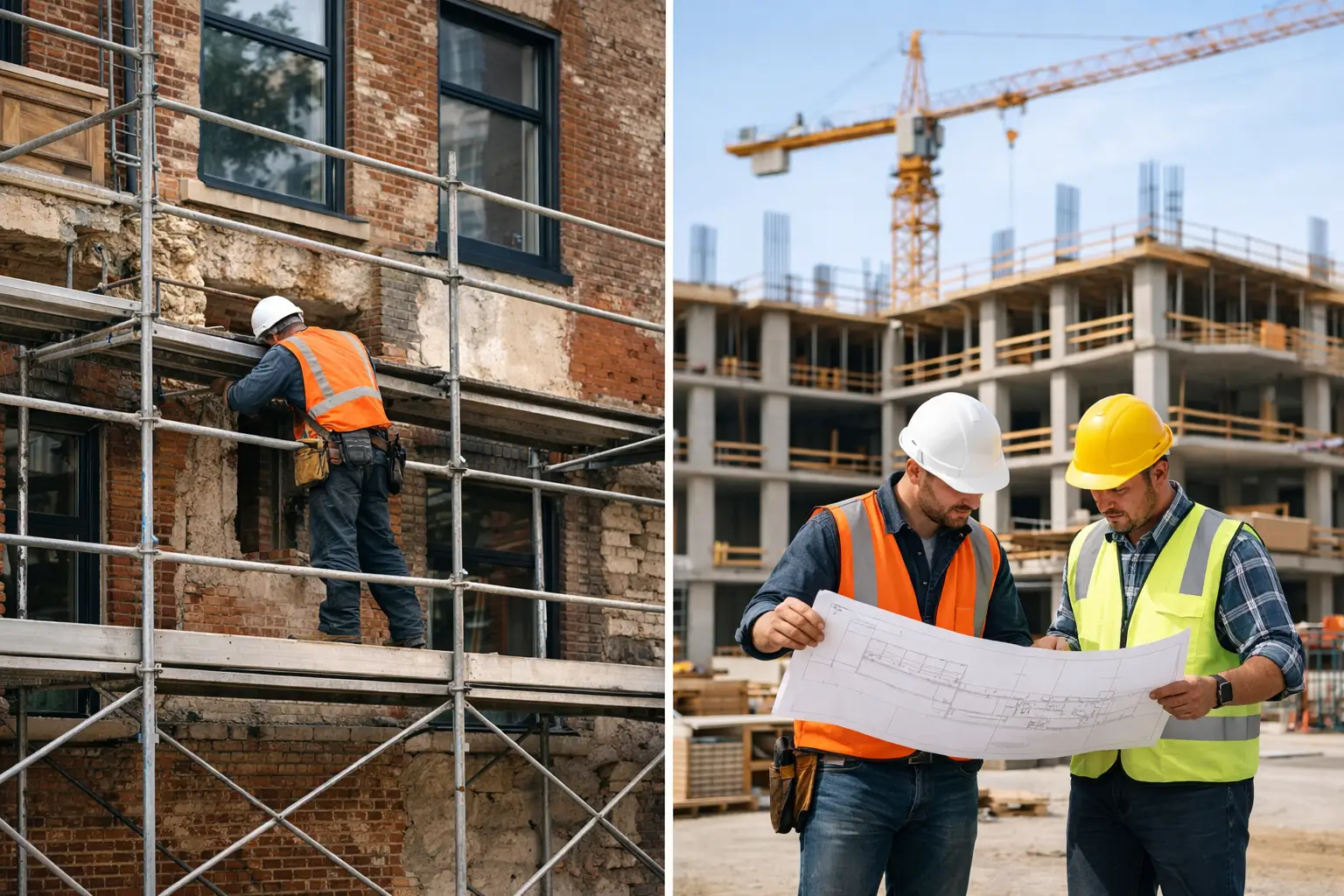
When a property starts driving up utility bills, comfort complaints, or maintenance costs, owners usually face a hard choice: building retrofit vs new construction. It sounds like a design decision, but in practice it is a business decision. The right path affects capital planning, operating costs, tenant satisfaction, compliance, and long-term asset performance.
For most existing properties, the answer is not as simple as saying new buildings are more efficient. New construction can deliver excellent performance, but it also comes with higher upfront costs, longer timelines, permitting complexity, and significant embodied carbon. A well-executed retrofit can often capture a large share of the energy savings at a fraction of the disruption and capital expense. That matters to homeowners trying to lower monthly bills, multifamily operators protecting NOI, and utility partners responsible for measurable demand reduction.
Building retrofit vs new construction: what changes the math
A retrofit improves an existing building through targeted upgrades such as insulation, air sealing, HVAC improvements, lighting, controls, water heating, and building envelope work. New construction starts over with a new structure designed to meet current code or higher performance targets.
On paper, new construction may look cleaner because everything begins from a blank slate. In the field, the comparison is more complicated. Existing site conditions, structural integrity, occupancy, financing, code triggers, equipment age, and utility incentives all influence the result. That is why the best decision usually comes from performance analysis rather than assumption.
If the structure is fundamentally sound, retrofitting often wins on speed and return. You preserve the asset, improve efficiency, and reduce waste. If the building has severe structural failure, functional obsolescence, or safety issues that make upgrades impractical, new construction may be justified. The point is not that one approach always beats the other. The point is that owners need to compare lifecycle value, not just first impressions.
Cost is not just the construction budget
Many owners initially compare retrofit and new construction by looking at project price alone. That is too narrow. A better comparison includes total capital cost, financing burden, temporary relocation or vacancy, demolition expense, permitting, schedule risk, and future operating savings.
Retrofits usually require less capital than tearing down and rebuilding. For a homeowner, that can mean upgrading insulation, ductwork, windows, and HVAC without taking on the full cost of a new home. For a multifamily property manager, it can mean improving dozens or hundreds of units while keeping the property in service. For utilities and program partners, retrofits can stretch incentive dollars further across more buildings and produce broader demand-side impact.
New construction can still make financial sense in select cases, especially when a building is beyond practical repair or when a site redevelopment plan will generate far greater revenue than the current asset. But for owners focused on reducing energy use and lowering operating costs in an existing building, retrofits often offer the stronger near- to mid-term payback.
That is especially true when the work is targeted. Replacing a failing HVAC system without addressing air leakage may leave savings on the table. Pairing envelope improvements with right-sized equipment and controls tends to produce better results because the systems work together.
Energy performance depends on execution, not just age
A common misconception is that a new building will automatically outperform a retrofitted one. Sometimes it will. Sometimes it will not.
New construction has the advantage of integrated design. Teams can orient the building correctly, specify high-performance materials, and coordinate systems from day one. But the final result still depends on installation quality, commissioning, and actual operation. A poorly executed new building can underperform quickly.
Retrofits work differently. Instead of rebuilding everything, they focus on the biggest energy losses first. In many existing homes and multifamily properties, those losses are not mysterious. They are in leaky envelopes, outdated HVAC equipment, poor ventilation balance, inefficient lighting, and aging water heating systems. Correcting those problems can produce meaningful reductions in energy use without replacing the entire structure.
For this reason, building retrofit vs new construction should be evaluated through expected performance outcomes. How much energy can realistically be saved? How will peak demand change? What will happen to comfort, indoor air quality, and maintenance needs? Owners who ask those questions usually make better investment decisions than owners who focus only on age or appearance.
Time, disruption, and occupancy matter more than many owners expect
Schedule can be the deciding factor.
A homeowner may not be able to wait through demolition, design, permitting, and a full rebuild. A multifamily operator may not be willing to absorb prolonged vacancy or tenant disruption. A utility program may need savings within a specific program year. In all of those cases, retrofit has a major advantage.
Targeted upgrades can often be phased. Buildings can remain occupied. Improvements can be prioritized around failing equipment, seasonal load issues, or budget cycles. That flexibility is valuable because it turns energy improvement into an operational plan rather than a one-time all-or-nothing event.
New construction is less flexible by nature. It can solve many problems at once, but it also requires a larger commitment, more coordination, and a longer path to results. If your goal is measurable savings on a practical timeline, retrofit often aligns better with how real properties are financed and managed.
Carbon impact is larger than the utility bill
Energy efficiency conversations often focus on monthly savings, and for good reason. Lower utility costs are immediate and measurable. But the environmental impact of the decision also matters.
Retrofitting an existing building typically avoids much of the embodied carbon tied to demolition and new materials. That can make retrofit the lower-carbon option even before operational savings are counted. For owners with sustainability commitments, and for utility or program stakeholders tasked with reducing emissions at scale, this is a serious advantage.
New construction can deliver low operational energy use, especially with high-performance design and electrification. Even so, the carbon cost of replacing a building is real. If an existing structure can be improved to perform well, preserving and upgrading it may offer a better total environmental outcome.
When new construction is the better call
Retrofit is often the practical choice, but not always.
If a building has extensive structural damage, chronic moisture failure, hazardous material issues that make renovation uneconomical, or a layout that cannot support current use, starting over may be the smarter investment. The same is true when codes, zoning, or redevelopment goals point clearly toward replacement.
There are also cases where energy goals are secondary to broader business goals. A developer may need greater density. An owner may need a complete repositioning of the asset. In those situations, new construction is not simply an efficiency decision. It is part of a larger portfolio strategy.
The key is honesty about the building condition and the project objective. If you want lower bills, better comfort, and stronger performance from an existing property, a retrofit deserves serious consideration before demolition enters the picture.
How to decide between building retrofit vs new construction
The right process starts with evaluation, not guesswork. Review the building envelope, equipment condition, occupancy patterns, maintenance history, utility usage, and capital constraints. Then model what targeted upgrades can achieve compared to replacement.
For homeowners, that may mean identifying which improvements will cut energy waste fastest and most reliably. For multifamily operators, it means looking at unit turnover, common-area loads, tenant comfort, and payback across the property. For utility and implementation partners, it means verifying that the project can deliver measurable and repeatable demand reduction.
This is where technical expertise matters. Good retrofit planning does more than recommend equipment. It connects building conditions to real savings outcomes. It also helps avoid one of the most common mistakes in this space: investing in visible upgrades that do not solve the underlying performance problem.
Performance Energy approaches this work with that outcome-first mindset. The goal is not to sell complexity. The goal is to improve building performance in ways that lower consumption, reduce costs, and stand up to measurement.
The better question is not which is newer
Owners often frame the issue as old versus new. A better question is which investment produces the strongest result for the property you actually have.
If the building is sound, a retrofit can be the faster, less disruptive, and more cost-effective path to lower energy use. If the asset is no longer viable, new construction may be the right move. What matters is choosing based on performance, lifecycle cost, and measurable outcomes rather than assumption.
The strongest projects start when owners stop asking what sounds modern and start asking what will actually reduce waste, improve comfort, and protect long-term value.