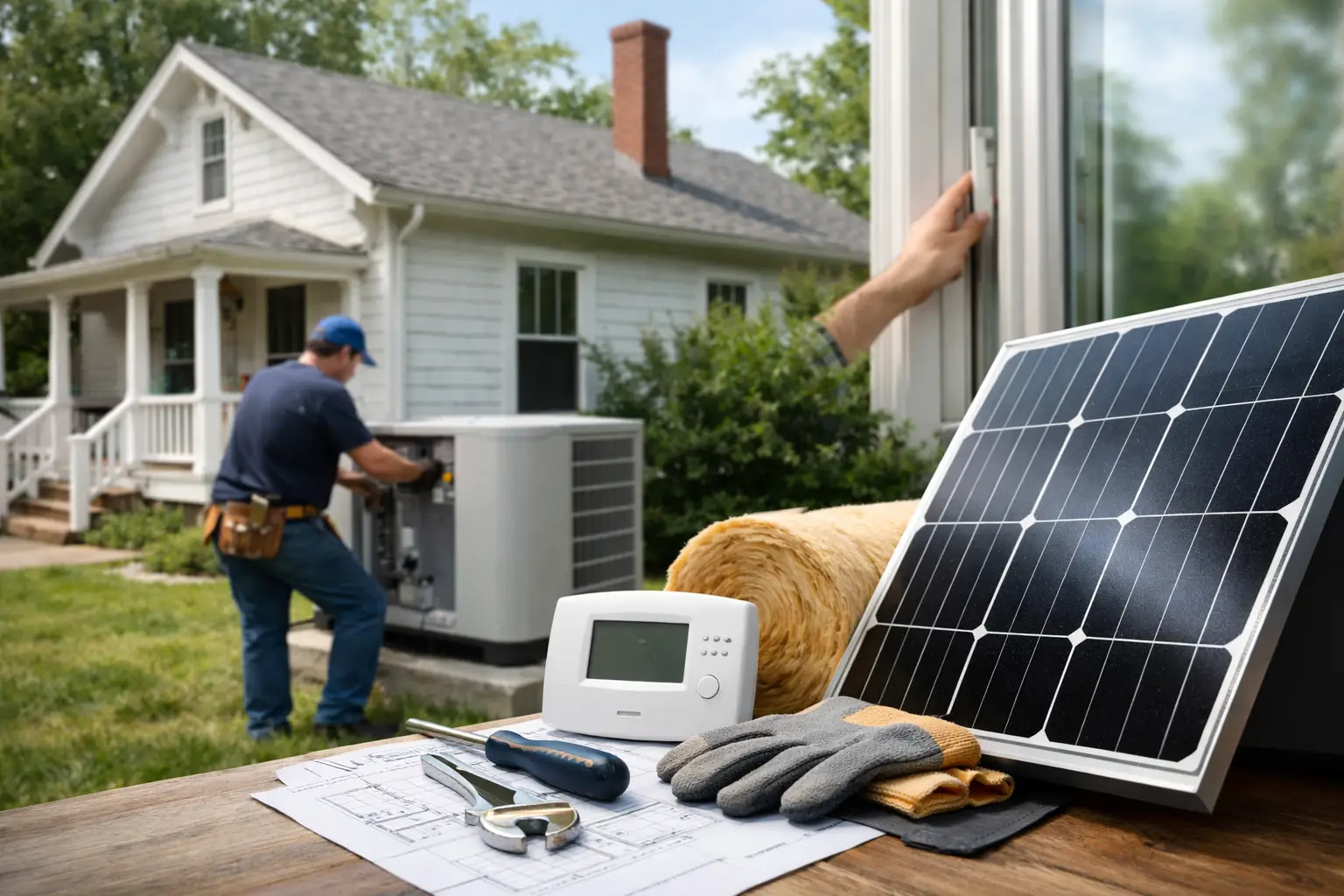
Older homes rarely fail all at once. They lose performance one small weakness at a time – attic heat gain, leaky ductwork, underinsulated walls, outdated lighting, aging HVAC equipment, and air leaks around doors, windows, and penetrations. That is why retrofit solutions for older homes work best when they are planned as a system, not treated as a series of isolated fixes.
For homeowners, that often means lower electric bills and fewer hot or cold rooms. For multi-family operators, it means controlling operating costs without the disruption of full redevelopment. For utility and program stakeholders, it means measurable demand reduction from existing building stock. The opportunity is significant because older homes and older residential buildings usually have the most room for improvement.
Why retrofit solutions for older homes need a whole-building approach
A home is an interconnected system. When one component changes, others respond. Replacing an air conditioner without addressing duct leakage or attic insulation may improve equipment efficiency on paper, but the building can still waste energy every day. Air sealing a structure without considering ventilation can also create unintended indoor air quality issues.
That is where many retrofit projects underperform. The problem is not the technology. The problem is sequencing, diagnostics, and installation quality. Strong retrofit work starts by identifying where energy is actually being lost, then prioritizing upgrades that produce the best combined effect.
In practical terms, older homes often benefit most from improvements to the building envelope first, then mechanical systems, then controls and lighting. That order is not absolute. In some properties, failing equipment forces a different sequence. But the principle is consistent: the load should be reduced before oversized or unnecessary equipment is installed.
The highest-impact upgrades in older homes
The best retrofit strategy depends on the age, layout, condition, and usage of the home or property. Still, a few upgrade categories consistently deliver strong results.
Air sealing and insulation
In many older homes, conditioned air escapes through the attic, crawlspace, wall gaps, recessed lighting, plumbing penetrations, and poorly sealed duct boots. These leaks drive up heating and cooling demand and make rooms harder to keep comfortable.
Air sealing is often one of the most cost-effective measures because it addresses hidden waste that runs every day. Insulation then helps slow heat transfer through the roof, walls, and floors. Attics usually offer the clearest return because they are accessible and tend to be underinsulated in older properties.
The trade-off is that insulation alone does not solve uncontrolled air movement. If an attic is simply topped off with more insulation while bypasses remain open, performance gains can fall short of expectations.
Duct sealing and airflow correction
Older duct systems are frequently a major source of loss, especially in homes with ducts routed through hot attics or vented crawlspaces. Leaks can dump conditioned air into unconditioned spaces while pulling in dust, humidity, and heat.
Duct sealing improves delivered efficiency. Airflow balancing also matters. Even efficient HVAC equipment cannot perform well if some rooms are over-supplied and others are starved. This is one reason comfort complaints and high bills often appear together.
For multi-family buildings, duct and ventilation corrections can create savings across many units at once. That makes them especially valuable in properties where small inefficiencies repeat at scale.
HVAC replacement with proper sizing
Many older homes operate with equipment that is either inefficient, near failure, or incorrectly sized. Replacing that equipment can reduce consumption, but only if the system is selected based on actual building conditions.
Oversizing is common. Owners may assume bigger equipment cools better, but oversized systems tend to short cycle, leaving humidity control and comfort behind. Once air sealing and insulation reduce the load, a smaller and better-matched system may be the smarter choice.
This is where technical expertise matters. Equipment efficiency ratings are useful, but field performance depends on sizing, installation, refrigerant charge, duct design, and controls. Guaranteed results come from execution, not just equipment specifications.
Lighting and controls
Lighting upgrades are straightforward compared with envelope or HVAC work, but they still produce meaningful savings, especially in common areas, multi-family properties, and homes with older fixtures. LED conversions lower electrical use and maintenance needs at the same time.
Controls extend those gains. Programmable or smart thermostats, occupancy-based lighting strategies in shared spaces, and scheduling improvements can reduce waste without affecting usability. Still, controls are not a substitute for correcting core building inefficiencies. They work best after larger performance issues are addressed.
Water heating and related systems
Domestic hot water can be a significant operating cost in older buildings. Upgrading water heaters, insulating hot water lines where practical, and correcting standby losses can cut energy use without major structural work.
In multifamily settings, central hot water systems deserve close attention because even modest efficiency gains can translate into meaningful annual savings. As with any retrofit, the value comes from matching the solution to the actual usage pattern and equipment condition.
What homeowners should prioritize first
For single-family homeowners, the biggest frustration is usually simple: bills keep rising, but the house still feels uneven and uncomfortable. The answer is not to start with the most visible product. It is to identify the biggest energy losses first.
A focused assessment should determine where the home is leaking air, how insulation is performing, whether ducts are losing conditioned air, and whether the HVAC system is operating efficiently. From there, the most cost-effective path often begins with air sealing, attic insulation, and duct improvements before major equipment replacement.
Window replacement is a good example of where expectations need to be realistic. In some older homes, windows do contribute to heat gain and loss. But they are not always the first or best investment if the attic, ductwork, and air leakage have not been addressed. New windows can improve comfort and appearance, but they do not automatically produce the fastest payback.
What multi-family owners and managers should consider
For apartment operators and property managers, retrofit decisions are rarely about one unit. They are about portfolio performance, resident comfort, maintenance burden, and controllable expense.
That changes the analysis. A measure with moderate savings per unit can become very attractive when multiplied across dozens or hundreds of residences. Common area lighting, central systems, in-unit HVAC upgrades, domestic hot water improvements, and envelope deficiencies all need to be evaluated through an operational lens.
Disruption also matters. The best retrofit plan is not always the one with the largest theoretical savings. It may be the one that balances measurable reduction with realistic installation schedules, resident access, and capital planning. A technically sound partner helps owners avoid projects that look efficient in a spreadsheet but create avoidable friction on-site.
Why measurable results matter for utility and program partners
Utility and implementation partners need more than good intentions. They need retrofit execution that produces verifiable savings, supports demand-side goals, and scales across eligible building stock.
Older homes are a strong target because baseline inefficiencies are often substantial. But program success depends on consistency – consistent diagnostics, consistent installation standards, and consistent reporting. Without those elements, projected savings can drift away from actual results.
That is why outcome-driven retrofit delivery matters. Performance Energy approaches retrofit work with that standard in mind, helping stakeholders pursue demand reduction and sustainability goals with practical improvements that can be implemented in the field and measured over time.
Choosing retrofit solutions for older homes without wasting budget
The strongest retrofit plans are not built around guesswork or one-size-fits-all packages. They are built around building conditions, occupant needs, and expected return.
If a home has severe attic heat gain and duct leakage, that is where the budget should go first. If a multifamily property is dealing with aging mechanical systems and high common-area electrical use, the sequence will look different. If a utility program is focused on peak demand, certain measures may carry more weight than others.
What stays constant is the need for disciplined evaluation and qualified implementation. Older homes can absolutely deliver major efficiency gains, but only when improvements are selected, installed, and verified as part of a coordinated strategy.
The right retrofit does more than lower consumption. It makes an older home perform with less waste, more comfort, and greater confidence that the money spent is producing real results.