
A hot upstairs bedroom, cold rooms near exterior walls, and utility bills that keep climbing often point to the same hidden problem. Knowing when should insulation be replaced helps homeowners and property operators address energy waste before it becomes a larger comfort, moisture, or maintenance issue.
Insulation does not come with a single expiration date. Some materials can perform for decades when they stay dry, properly installed, and undisturbed. But age alone is not the standard that matters most. The real question is whether the insulation is still creating a continuous thermal barrier that supports lower energy use, consistent indoor temperatures, and healthy building conditions.
When Should Insulation Be Replaced Instead of Left Alone?
Replacement is usually justified when insulation is damaged, contaminated, missing, compressed, wet, or no longer adequate for the building’s needs. An attic may contain insulation that looks acceptable from a distance but has settled below effective depth, leaving large gaps at the eaves or around mechanical equipment. Wall insulation may be present but poorly installed, allowing heat to move through cavities and framing.
For a single-family homeowner, the warning may be a heating and cooling system that runs too often without delivering consistent comfort. For a multi-family property, the signs may include repeated tenant complaints, uneven apartment temperatures, higher common-area utility costs, or units that are difficult to keep comfortable during peak summer and winter weather.
Utility and energy program stakeholders should also look beyond whether insulation exists. A retrofit measure only produces dependable demand reduction when installation quality, thermal coverage, and building conditions support the projected savings. Existing insulation that is incomplete or compromised can limit the performance of an otherwise well-designed energy upgrade.
It Is Wet, Moldy, or Has Water Damage
Wet insulation is one of the clearest reasons for replacement. Fiberglass, cellulose, and other common materials lose thermal effectiveness when saturated or repeatedly exposed to moisture. Moisture can also create conditions for mold growth, wood deterioration, and indoor air quality concerns.
Replacement should not begin until the source of water is identified and corrected. A roof leak, plumbing issue, condensation problem, or poorly vented attic can quickly damage new insulation as well. In many cases, the right sequence is moisture repair, air sealing, then insulation replacement.
It Has Been Contaminated by Pests or Debris
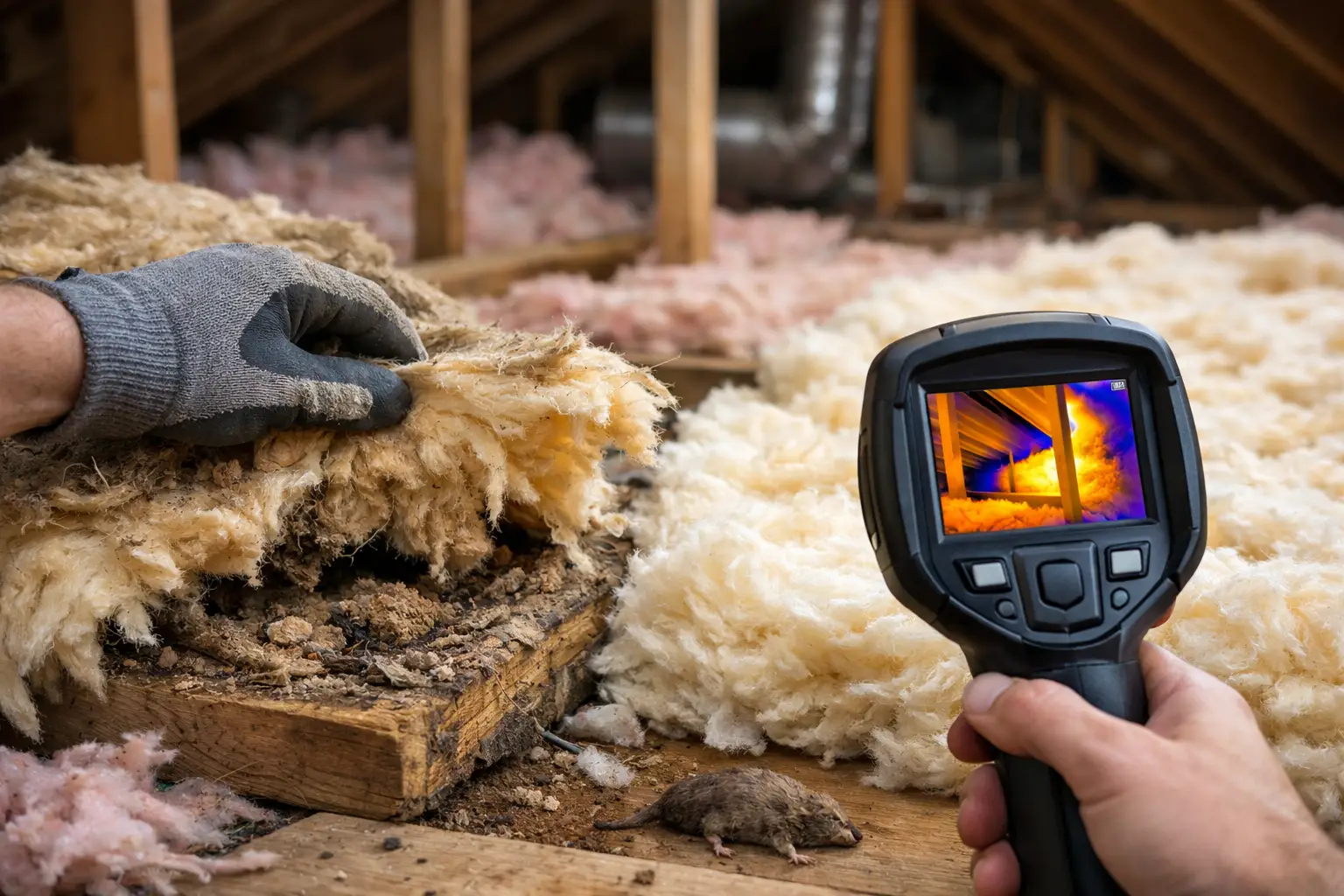
Rodent droppings, nesting materials, insect activity, and heavy debris can make existing insulation unsafe or unsuitable to retain. Contaminated insulation can hold odors and may expose occupants or maintenance staff to unhealthy conditions during repairs.
In an attic or crawl space, pest exclusion should be part of the scope. Removing insulation without sealing entry points simply creates an opportunity for another infestation. Property managers should treat recurring pest activity as both a maintenance concern and a building-performance concern.
It Is Compressed, Settled, or Uneven
Insulation works by trapping air. When it is flattened under storage items, compressed around ducts, or settled below its intended depth, its ability to resist heat transfer declines. Loose-fill insulation is especially prone to settling over time, although the extent varies by material, installation quality, and local conditions.
Uneven coverage matters as much as average depth. A few thin areas can create thermal weak points that undermine the rest of the attic. During an assessment, pay close attention to perimeter areas, attic hatches, recessed fixtures, duct chases, and spaces around framing transitions.
It Cannot Meet Current Performance Needs
Older homes and apartment buildings were often built with less insulation than current energy recommendations support. The insulation may not be visibly damaged, but it may be insufficient for the climate, building design, and equipment load.
Adding insulation can be more practical than full removal when the existing material is clean, dry, and evenly distributed. However, simply piling new insulation over old material is not always the best answer. Air leaks, bypasses, moisture issues, and damaged sections should be corrected first. Otherwise, the new layer may reduce heat loss while leaving the underlying causes of discomfort unresolved.
Signs Your Building May Need an Insulation Assessment
Energy bills alone do not prove that insulation needs replacement. Utility costs can also rise because of HVAC equipment problems, duct leakage, inefficient lighting, appliance loads, or changes in occupancy. Still, insulation deserves attention when high costs appear alongside comfort and building-condition issues.
Common indicators include:
- Rooms that are significantly hotter or colder than the rest of the building
- High heating or cooling run times during normal weather
- Drafts around ceilings, attic access points, exterior walls, or floor assemblies
- Ice dams in cold-weather regions or excessive attic heat in summer
- Visible water staining, mold, pest damage, or insulation that has shifted out of place
- Frequent tenant comfort complaints concentrated in top-floor, corner, or over-garage units
These signs should lead to a professional evaluation rather than an automatic replacement decision. The goal is to determine where energy is escaping and which improvements will deliver measurable results.
Why Air Sealing Comes Before New Insulation
Insulation slows heat flow, but it does not stop air leakage. Warm or cooled air can move through gaps around plumbing penetrations, wiring, attic framing, duct openings, and recessed lighting. Those leaks can carry moisture into attic and wall assemblies, increasing the risk of condensation and reducing overall efficiency.
Air sealing before insulation replacement is a critical quality step. It helps the insulation perform as intended and protects the building envelope from hidden moisture movement. For homeowners, that can mean more stable room temperatures and lower electricity bills. For multi-family operators, it can reduce waste across many units while improving tenant comfort and controlling operating expenses.
The best scope depends on the building. An attic retrofit may include sealing ceiling-plane penetrations, improving attic access insulation, correcting duct issues, and installing insulation to the required depth. A crawl space may require moisture management, floor insulation, and air sealing at rim joists. Wall upgrades may call for a more targeted approach based on cavity conditions and access.
Replacement Versus Adding More Insulation
Full replacement is not always necessary. If existing insulation is dry, clean, and not badly compressed, adding compatible material may be the most cost-effective route. This is common in attics where older insulation remains serviceable but falls short of the desired R-value.
Removal is more appropriate when contamination, moisture, extensive settling, or installation defects make the old material unreliable. It may also make sense when access is needed to identify air leaks, repair damaged ceiling areas, or correct building-envelope issues that cannot be addressed through an overlay.
For a portfolio of apartments or rental homes, decisions should be based on repeatable field data rather than assumptions. A consistent inspection process can identify whether a broad retrofit is justified or whether certain building types, top-floor units, or high-complaint locations should be prioritized first.
What a Quality Insulation Retrofit Should Deliver
A quality retrofit is more than a truckload of insulation. It begins with evaluating existing conditions, identifying the sources of heat loss and heat gain, and selecting measures that fit the building’s construction and energy goals.
The installation should provide complete coverage without gaps, maintain proper clearances around heat-producing fixtures and equipment, and avoid blocking required ventilation pathways. Just as importantly, the work should be verified. Depth, density, air-sealing details, and access-point treatment all influence real-world results.
Performance Energy approaches insulation as part of a larger building-performance strategy. That means focusing on the upgrades that reduce energy consumption, improve comfort, and support results that can be measured across individual homes, multifamily properties, and energy efficiency programs.
Make the Decision Based on Conditions, Not Guesswork
Do not wait for insulation to visibly fail before taking action. If a home or property has persistent comfort problems, unexplained energy costs, moisture evidence, or aging insulation with uncertain installation quality, an assessment can clarify the next step.
The most useful outcome is not simply new material in an attic or wall. It is a targeted plan that addresses the conditions causing energy waste and gives the building a better chance to perform consistently season after season.