
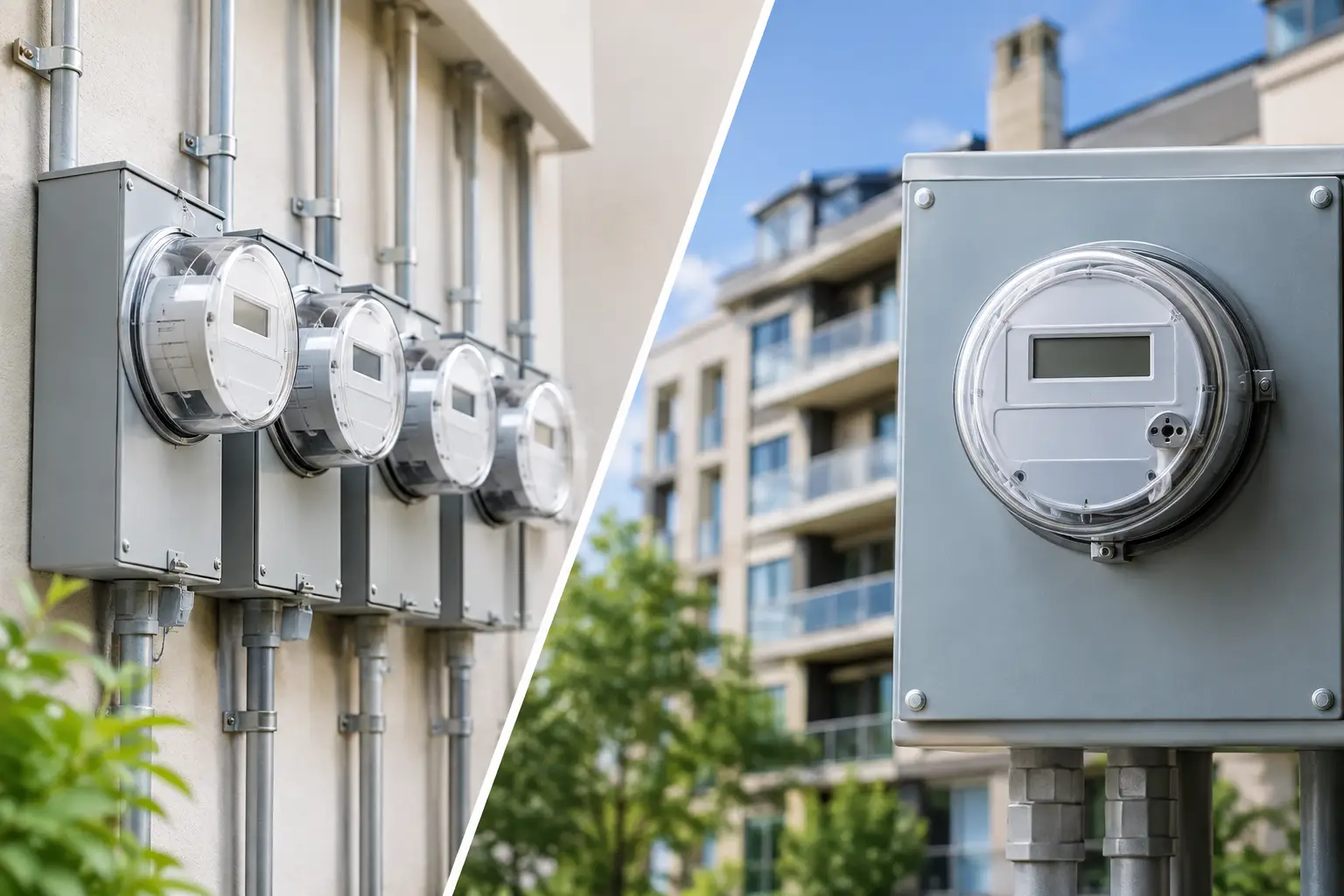
A single utility bill can hide the source of a property’s energy costs. When an apartment community is master-metered, management sees the total expense but may have little visibility into how individual units, common areas, equipment, and operating practices contribute to it. The choice between submetering versus master-metering determines who sees usage, who pays for it, and how effectively a property can turn energy data into lower costs.
For multifamily owners and managers, this is not simply a billing decision. Metering structure affects resident behavior, operating budgets, retrofit priorities, compliance responsibilities, and the ability to verify savings after an upgrade. The right approach depends on the building, local rules, utility setup, lease structure, and the outcomes ownership wants to achieve.
Submetering Versus Master-Metering: The Core Difference
Master-metering uses one primary meter for the entire property or building. The utility bills the owner or property operator for all electricity, gas, or water measured at that point. The owner then absorbs the cost, includes utilities in rent, allocates charges through a permitted formula, or uses another approved billing arrangement.
Submetering places additional meters downstream from the utility’s master meter. These submeters measure energy or water use for individual apartments, tenant spaces, or specific building systems. The property can use that data to bill residents based on measured consumption, subject to state and local regulations, lease terms, and applicable utility commission requirements.
The utility meter remains the official meter for utility billing. A submeter does not replace it. Instead, it gives the property a more detailed view of how energy is used after it enters the building.
That distinction matters. Master-metering shows the total bill. Submetering shows where the bill is coming from.
When Master-Metering Makes Sense
Master-metering can be a practical fit for older multifamily buildings, properties with all-inclusive rent structures, or sites where electrical distribution makes unit-level metering difficult and costly. It also provides a straightforward experience for residents because the property handles utility costs centrally.
For the operator, however, simplicity can come with limited accountability. If residents do not see the financial impact of their consumption, there is less direct incentive to reduce unnecessary use. A resident who runs air conditioning with windows open pays no more than a neighbor who actively conserves energy when utilities are included in rent.
This does not mean master-metered buildings cannot reduce consumption. They can. High-efficiency HVAC equipment, improved insulation, air sealing, lighting upgrades, smart controls, and water-saving measures can all lower whole-building usage. But without interval or unit-level data, it can be harder to identify which measures are producing the strongest results or where operational waste remains.
Master-metering is also common when common-area and unit loads are intertwined. In some older buildings, panels and circuits were not designed to separate apartment usage cleanly. Before choosing submetering, the property should assess the electrical infrastructure and determine whether the planned configuration can accurately distinguish private and common loads.
What Submetering Can Change
Submetering brings visibility to individual usage. That visibility supports more accurate resident billing, but its value extends beyond billing. It can help management identify unusually high consumption, investigate equipment problems, compare similar units, and measure the effect of efficiency improvements over time.
For example, if several comparable apartments use far more electricity than the rest of a building, management can look for a cause. The issue may be an aging HVAC unit, poor envelope performance, malfunctioning controls, unauthorized equipment, or a resident behavior pattern. Aggregate master-meter data rarely provides that level of direction.
Submetering can also create a clearer connection between consumption and cost. When residents receive bills based on their actual use, many become more attentive to thermostat settings, lighting, appliances, and water use. The resulting reduction will vary by property and resident population, so it should not be treated as an automatic savings guarantee. Still, direct feedback is often an effective part of an energy-management strategy.
For owners, a fair and transparent submetering program requires more than installing meters. Bills must be accurate, understandable, and issued consistently. Residents should know what is being measured, how charges are calculated, which fees may apply, and how to raise questions about a bill. Clear communication protects resident trust and reduces disputes.
Common-Area Loads Need Separate Treatment
A successful submetering design separates what belongs to individual residents from what belongs to the property. Hallway lighting, laundry rooms, elevators, exterior lighting, leasing offices, pool equipment, central mechanical systems, and parking areas generally remain owner-paid common loads.
If a unit submeter captures a portion of a common-area load, the billing arrangement can become inaccurate and difficult to defend. Electrical mapping and field verification are essential before a property begins tenant billing. This is one reason metering should be evaluated alongside a broader building-performance assessment rather than treated as a standalone equipment purchase.
The Financial Trade-Offs
The financial case for submetering starts with installation cost, but it should not end there. A property may need new meters, communications equipment, panel work, data management, billing administration, maintenance, and customer-service processes. In buildings with complex or outdated wiring, the electrical work can be significant.
In return, the property may reduce owner-paid utility expenses, recover eligible resident usage costs, gain better data for capital planning, and improve the ability to validate retrofit performance. Properties that currently include electricity or water in rent may see a particularly meaningful change in cost allocation after implementing a compliant submetering program.
Master-metering avoids much of the administrative burden. Yet owners retain full exposure to utility-rate increases and resident consumption. When a building has high energy costs but little insight into their drivers, the apparent savings from avoiding submetering may be offset by years of preventable waste.
The strongest decision is based on a site-specific analysis. Consider the property’s current utility expense, occupancy pattern, electrical layout, planned capital improvements, resident billing model, and expected ownership horizon. A property preparing for a major electrical or HVAC retrofit may find that it is more cost-effective to address metering during the same project.
Metering Is Not a Substitute for Efficiency Upgrades
Submeters measure consumption. They do not reduce it on their own.
A building with failing heat pumps, inadequate insulation, duct leakage, inefficient lighting, or poor controls can still produce high bills after submetering. The difference is that the cost may shift from the owner to residents, which can create dissatisfaction without solving the building’s underlying performance problem.
For that reason, owners should pair metering decisions with an assessment of the building envelope and major energy systems. If units have materially different efficiency levels, individual billing may expose residents to uneven costs caused by building deficiencies rather than their own behavior. Addressing those deficiencies first, or as part of the same improvement plan, creates a more equitable and durable result.
Performance Energy approaches retrofit planning with measurable outcomes in mind: reduced energy use, lower utility costs, and improved building performance. Metering data can strengthen that process by establishing a clearer baseline, identifying priority opportunities, and helping verify whether completed upgrades are delivering expected results.
Compliance and Resident Communication Are Essential
Submetering rules vary by state, municipality, utility territory, and housing type. Some locations regulate meter accuracy, permissible billing practices, administrative fees, resident notices, dispute procedures, and disclosure language. Affordable housing programs, rent-controlled properties, and properties with existing utility allowances may have additional requirements.
Before moving from master-metering to resident billing, property owners should confirm the applicable legal and regulatory framework. They should also review lease language and develop a clear implementation plan. Residents need advance notice, a plain-language explanation of the change, and a reliable way to access billing information and support.
The goal is not merely to pass through costs. It is to create an accurate, transparent system that supports responsible energy use while respecting resident protections.
Choosing the Right Metering Strategy
Master-metering may be the better option when a building’s infrastructure cannot support accurate unit-level measurement, when utilities are intentionally included as part of the property’s market position, or when installation and administration costs outweigh expected benefits.
Submetering may be the stronger choice when an owner needs unit-level visibility, wants to align consumption with payment responsibility, and has a building layout that can be metered accurately. It is especially valuable when paired with targeted energy upgrades and a plan to track performance over time.
The practical question is not whether one model is universally better. It is whether the metering structure helps the property control costs, treat residents fairly, and make better investment decisions. Start with the building’s actual energy use and electrical layout, then build a plan that makes every measured kilowatt-hour count.